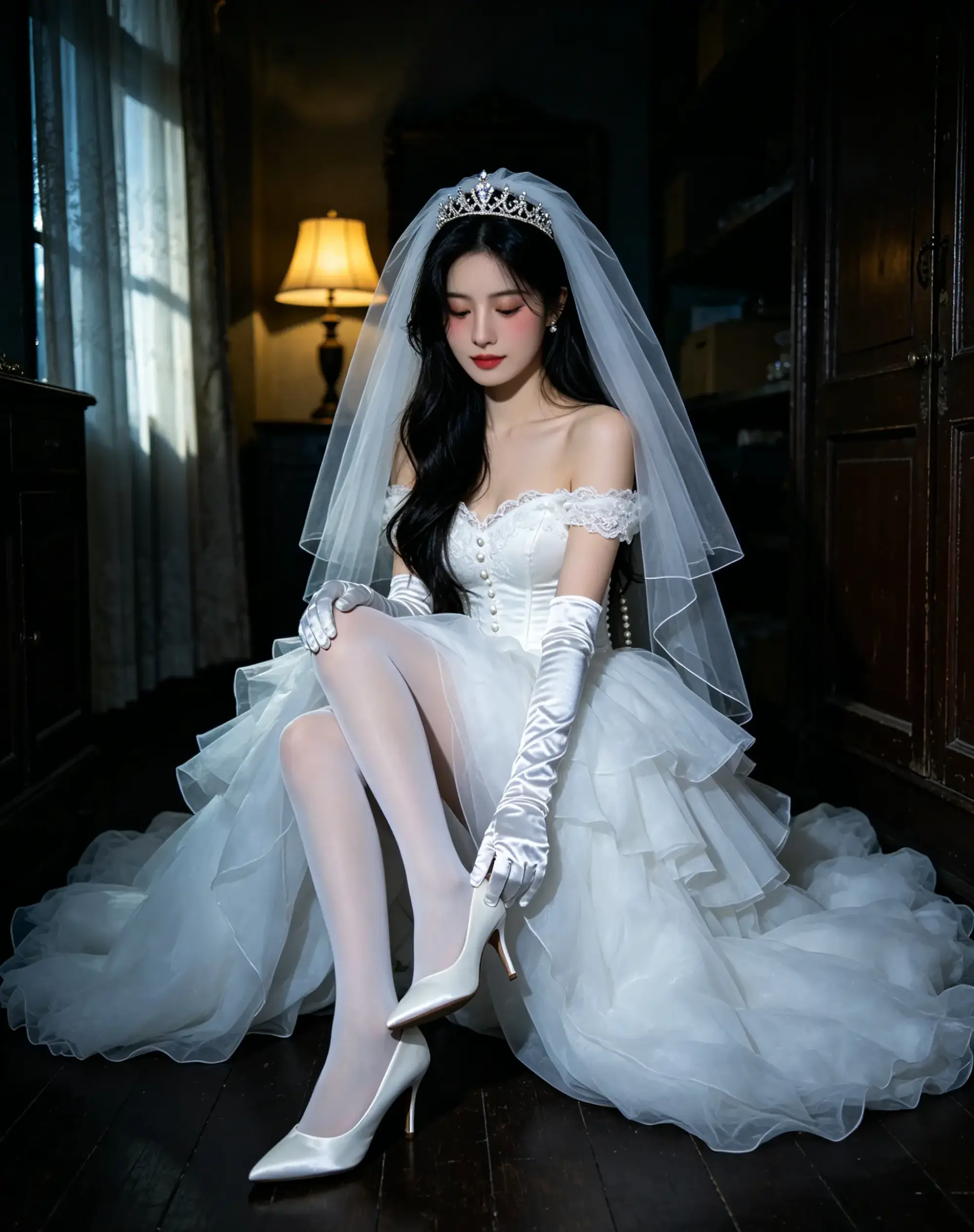
Bound Marriage Eternal Night: The CEO's Wedding Gown Cage
Article Summary
"Here it is," Tailor Chen nodded, placing the item on the velvet-covered workbench. "Your 'wedding dress' – it's finished." He pulled back the curtain by the wall. Wang Xiulan's gaze fell upon it, and her breath hitched. It was a white wedding dress, displayed on a mannequin. From the outside, it was practically a work of art. An off-the-shoulder neckline, perfectly exposing her collarbones and shoulder line; a cinched waist, paired with a voluminous, floor-sweeping skirt; the entire outer layer of the dress was covered in fine pearls and hand-embroidered silver vine patterns, the vines winding down from the neckline, through the waist, all the way to the hem of the skirt. The light caught them, the pearls refracting a gentle glow, like countless tiny stars embedded in the white fabric. "The exterior is made exactly as you described," Tailor Chen's voice was calm, as if he were introducing an ordinary garment. "Take a closer look at the inner layer." He extended his rough hands and carefully pulled aside the snow-white sheer fabric of the dress's outer layer. Wang Xiulan's pupils dilated slightly. Beneath the snow-white sheer fabric, another layer was revealed, something entirely different. Black. The inner layer was a full-body leather restraint suit. Imported Italian black lambskin, it exuded a soft, understated sheen under the light. Wang Xiulan reached out to touch it – it was soft, incredibly supple, not as cold and stiff as she had imagined, but rather possessed a strangely docile texture, as if this leather was born to encase the human body. The design of the restraint suit was extremely precise. Starting from the neck, it covered the shoulders, upper arms, forearms, wrists, torso, waist, abdomen, thighs, knees, calves, and ankles – each joint had multiple leather straps and metal clasps, bringing every inch of the body under control. Wang Xiulan's fingers traced the neatly arranged locking points of the clasps. The cold metal fasteners pressed against her fingertips, one by one, like a row of silent teeth. "I counted, exactly twenty locking points," Tailor Chen stood beside her, beginning to explain each one. "Two for the wrists, which can be fastened together or separately; two for the elbows, allowing for a maximum bend of ninety degrees; two for the shoulders, completely immobilizing the upper arms at the sides, preventing any lifting; two for the waist, to cinch the abdomen, with adjustable tightness for breathing; four for the thighs – two on the inside and two on the outside, spaced ten centimeters apart, which, when locked, prevent the legs from separating beyond shoulder width; two above and two below each knee, which, when locked, keep the legs perfectly straight, unable to even slightly bend; two for the ankles, to fasten them together, with no more than five centimeters between the feet." He paused, then pointed to the neckline of the restraint suit. "And one more – the neck restraint ring. It's a double-layer structure, with the outer layer being the lace collar decoration of the wedding dress, and the inner layer being a reinforced leather loop. Once worn, the head's rotation range is limited to no more than fifteen degrees. This means that if you want to look at someone beside you, you'll have to turn your entire body." "There's one more location," Wang Xiulan's gaze landed on the very top of the restraint suit. "The forehead," Tailor Chen nodded. "Straps for securing the tiara. They loop from the top of the head down to the chin, with four leather straps that can be locked into the base of the tiara. Once the tiara is on, it cannot be removed." Wang Xiulan was silent for a moment. Then she asked a repeated question: "Is it tight enough?" "Tight," Tailor Chen's answer was crisp and decisive, without a hint of hesitation. "Once worn, you won't be able to move anything except your toes and fingers. If you wanted, I could add restraints for the fingers too – but you didn't request that at the time." "No need for the fingers," Wang Xiulan said. "Immobility is enough." She then looked at the accompanying accessories. White stockings – packed in a transparent sealed bag, folded neatly. Tailor Chen took them out and unfolded them for her to see. "High-denier, thickened, opaque, with a texture denser than any stockings sold on the market. High-waisted design, they can be pulled up above the waist and used in conjunction with the waist clasps of the restraint suit – the metal base of the waist clasps has a slot designed to grip the edge of the stockings, preventing them from slipping." Wang Xiulan took the stockings, rubbing the fabric between her fingers. They were indeed thick, yet retained the smooth feel of silk. "The heels and toes are reinforced," Tailor Chen added. "Paired with high heels, they won't cause chafing when walking." High-heeled wedding shoes – white satin, the toes adorned with fine pearls, as perfect as a work of art. The heels were a full twelve centimeters, with an elegant curve, reinforced with a steel core, sturdy enough to bear the full weight of an adult. Tailor Chen took the shoes and pointed to a nearly invisible small button on the inside of the shoe opening. "This has been specially treated. When pressed, an internal metal ring tightens, locking securely to the curve of the ankle. Without your special key, they cannot be removed." He pressed the button, and a faint click was heard. Then he handed her the shoe. "Try the feel." Wang Xiulan took the shoe, her finger pressing the button, pushing it down firmly – click. She pressed it again, then released. Press again, and it locked. "The keys?" Tailor Chen took out a delicate little key from his apron pocket, about two centimeters long, silver-white, with a simple design but a distinctive bit. "There are two in total, both here. One for you to keep, and one as a spare," he said. "But I advise you to hide them well – if the wearer gets hold of them, the entire design would be in vain." The waist was cinched incredibly high, precisely at the narrowest point just below the rib cage. Three vertical boning channels adorned each side of the waistline, and a touch confirmed they were made of a highly resilient whalebone substitute. From the waist down, the skirt flared dramatically, appearing to be held aloft by some unseen force, its circumference easily estimated at over three meters. Viewed from the front, the wedding dress presented an elegant A-line silhouette, while from the side, it curved into a graceful S-shape. The asymmetrical hem, shorter in the front and trailing nearly two meters behind, was also embellished with intricate embroidery and beadwork. I took a deep breath, my gaze continuing downward. Besides the gown itself, several other items were nestled within the cabinet, each swaddled in soft white velvet and neatly arranged on the lower shelf. I crouched down and reached for them one by one. With each layer of velvet I unwrapped, a tremor of unease intensified within me. The first item was a pair of white satin high-heeled wedding shoes. My initial sensation upon picking them up was their lightness—an unexpected, almost ethereal weight. The uppers were crafted from matte white satin, possessing a texture as smooth and delicate as fine cream. The toes were elegantly almond-shaped, their edges traced with a border of tiny seed pearls. Silver vine embroidery, echoing the motifs on the gown, adorned the shoe's surface. The soles were a pale gold genuine leather, promising a snug fit that would mold perfectly to the arch of the foot. Then, my attention was drawn to the heels. The heels—they were impossibly slender. Thinner than any high heel I had ever encountered. They were like metallic needles, extending from the precise center of the sole, curving gracefully before terminating in a heel tip no larger than a fingernail. I estimated their height, and my heart gave a lurch—these were undoubtedly well over ten centimeters. I measured with my finger, from the top of the heel to the tip, and it was nearly the width of my palm. At least fifteen centimeters. Fifteen-centimeter heels. I set the shoes down, then picked them up again, comparing them to my hand. I placed the sole against my palm, measuring the length. My feet were a European size 37, and these shoes appeared to be roughly the same size. But wearing them would force my instep into an almost perfectly straight line, with all my weight bearing down on my toes and arches. Walking in these would be impossible—even standing would be a precarious feat. A chilling realization suddenly dawned on me: wearing these shoes, I wouldn't be able to walk on my own. If I needed to move, there were only two options—either be painstakingly assisted, taking slow, agonizing steps, or be carried entirely, my feet completely off the ground. These were indeed wedding shoes. Wedding shoes that would render me incapable of anything other than standing still and smiling, or being carried into the bridal chamber. I placed the shoes back down, my fingers trembling slightly, and unwrapped the second piece of velvet. The second item was a pair of long white silk gloves. Their length, by my estimation, extended past the elbow, and when fully pulled up, they would likely reach the upper arm, close to the shoulder. The fabric was a double-layered, thickened silk. The outer layer was a matte white silk, while the inner lining was a whisper-thin silk, feeling as slick as flowing water. A row of delicate white pearl buttons, twelve in total, each no larger than a seed pearl, ran down the back of the gloves from the wrist to the crook of the elbow. The buttonholes were meticulously finished. I attempted to pick up the fingertip of a glove with two fingers—the fingers of the gloves were crafted to be exceptionally form-fitting, with fine stitching at the seams. The range of motion for the fingers would be significantly restricted when worn, particularly the angle of opening and closing between the thumb and index finger, which was noticeably limited by the fabric. The inner edge of the diadem was lined with a thin strip of non-slip silicone, but in addition to that, there were four delicate metal straps that extended from the top of the head to behind the ears, each ending in a small keyhole. This wasn't a diadem meant to simply rest on the head – it needed to be secured, locked from the jawline with the straps. Connected to the diadem was a three-layered veil. The outermost layer was a chest-length lace mantilla, its white lace forming a fine honeycomb pattern. Looking through it, one could only discern blurred outlines and shadows. The middle layer was a waist-length soft veil, as thin and light as a cicada's wing, ethereal and transparent. The innermost layer was a floor-length trailing veil, cascading from the crown of the head all the way to the ground. I roughly unfolded it to gauge its length – from my head to the floor, there was at least a meter of excess, meaning this inner veil was at least three meters long. All three layers of the veil were sewn permanently to the base of the diadem, unremovable. This meant that once the diadem was put on and locked, these veils would cover everything from the top of the head to the waist, to the ground – like a white cocoon, encasing the wearer from head to toe. The fourth item was a pair of white, high-denier stockings. When I unfolded the stockings, they felt much thicker than I had anticipated. These weren't the sheer, gossamer-thin stockings found on the market, but a reinforced, high-denier, opaque white pair. They felt dense and smooth to the touch, like some specially woven fabric. The waistband was designed to be high, clearly capable of reaching above the waist, and it was trimmed with a band of very fine silver lace. I stretched the stocking opening with my fingers to test the elasticity – the rebound was excellent, suggesting a very snug fit that would leave no wrinkles or slack once worn. The toes of the stockings were reinforced, and there was a distinct strengthening layer at the heel, likely to accommodate the fifteen-centimeter heels. This reinforcement would prevent the stockings from tearing under the immense pressure on the toes and heels during prolonged standing or when being held. I carefully re-wrapped everything in velvet cloth and placed it back in the cabinet, then closed the door. I stood there, looking down at the re-locked padlock, the images replaying in my mind – the layered white wedding dress, the fifteen-centimeter stiletto wedding heels, the long gloves that would render my hands useless, the diadem that needed to be locked from the jawline, the three-meter trailing veil, the high-waisted stockings that would tightly encase my legs… A complete bridal ensemble. Each piece was exquisitely crafted. But each piece – seemed designed to render one immobile. With those shoes on, I couldn't walk. With those gloves on, I couldn't grasp anything. With that diadem and veil, I couldn't see my surroundings. And the wedding dress – I dared not imagine if it had other mechanisms. What was Aunt Wang trying to do? Then, I discovered something. This wedding dress, from the neckline to the waist, from the hem to the train – Every measurement, perfectly matched my figure. I looked at the waist of the dress – it was the same size as my suit trousers. The width of the shoulder straps perfectly matched the width of my collarbones. The length of the hem, when I wore the heels, fell precisely to the ground. I reached out to touch the lining of the dress, my fingertips gliding over the smooth fabric, my heart pounding like a drum. This is my own home. No one can lock me up. I'm just trying it on. I straightened up and looked at myself in the mirror. The eyelets on those straps did exist, but the key wasn't in my hand—so what? The key should still be with Wang Xiulan, and as long as I didn't let her know, these eyelets were just for show. I could put it on. I could fasten it. But I wouldn't be locked. Because this place is safe. Because this is my home. Because no one would come to lock me. I took a deep breath, pushing down those anxieties. I stood in front of the mirror and turned around again—though my movements were clumsy due to the restraints, I was still very satisfied. I looked at myself in the mirror, wearing a wedding dress, a crown, a veil, long gloves, and wedding shoes. I looked like a real bride. I slowly lay down on the bed. The skirt of the wedding dress spread out beneath me, like a blooming white flower. The leather restraints tightened slightly with my movements, reminding me of the gentle confinement on my body. I closed my eyes. Just lying here for a while. Just feeling this sense of being enveloped. I wouldn't fall asleep. I wouldn't give it a chance to lock me. I was just... The night deepened outside the window, and only the sound of even breathing remained in the room. What she didn't notice was that the moment she closed her eyes, at the end of the corridor outside the bedroom door—though Wang Xiulan was not at home, the pinhole camera hidden within the crystal decorations of the master bedroom's chandelier was faithfully transmitting everything to an old house dozens of kilometers away. Wang Xiulan sat by the bedside, watching the real-time feed on her phone screen. On the screen, Su Wanqing was lying on the large bed in the master bedroom, wearing that white wedding dress. Her body was firmly bound by twenty-one leather straps—from wrists to upper arms, from knees to ankles, every joint was fixed. Yet, there was no pain, no fear on her face, only a deep, serene calm. She had fallen asleep. In that wedding dress that concealed a restraint suit. Under Wang Xiulan's camera. Wang Xiulan looked at the sleeping face on the screen, and a smile slowly spread across her lips. She picked up her teacup, took a sip, her gaze never leaving the image. She saw Su Wanqing move slightly in her sleep—the straps tightened accordingly, and the skirt of the wedding dress spread out beneath her. Her fingers unconsciously brushed over the snaps at her waist, as if confirming their presence even in her dreams. Wang Xiulan put down her teacup and reached into her pocket, pulling out an object. A small, silver key. It gleamed coldly in the light. She placed it in her palm, slowly closing her fingers, feeling the coolness of the metal seep into her skin. She had waited the entire night. Finally, this moment had arrived. The image flashed in her mind—Su Wanqing, in her wedding dress, standing in front of the mirror, fastening those snaps one by one. Twenty-one. Not a single one missed. She fastened all the snaps. And on those snaps, there were twenty-one eyelets. Each eyelet corresponded to a key. Wang Xiulan opened her eyes, looked at the silver key in her palm, and whispered a sentence—the sentence was so light, so light that she herself could barely hear it: "Good girl, you've finally put it on." I awoke from a dreamless sleep. The moment consciousness returned, the first thing I felt was the restraint on my body – the straps around my waist cinched me tight, my arms were pinned to my sides, my legs were confined to a few inches of movement, and a leather collar around my neck allowed only slight turns of my head. For a few moments, I was dazed, then all the memories flooded back. The wedding dress. The storage room on the third floor. Twenty-one straps. Those snaps. Those keyholes. I had slept the entire night in a wedding dress. This realization sank into my heart like a stone, sending ripples outward. I am a person who is extremely particular about my sleeping environment – the firmness of the mattress, the height of the pillow, the room temperature, the blackout level of the curtains; any deviation would leave me tossing and turning. Yet last night, wearing a wedding dress concealing a straitjacket, I lay on this bed, securely bound by twenty-one leather straps, and slept soundly until dawn. No waking up in the middle of the night. No restless turning. No anxiety and itching that had tormented me for months. I had a dreamless night. Morning light filtered through the gaps in the curtains, casting a long, slender golden shadow on the floor. Tiny dust motes danced in the air, and everything seemed so quiet, so peaceful. A few birds chirped outside, a gentle breeze rustled the curtains, and sunlight dappled the walls. I tried to sit up. But the restraints around my waist tightened, making this simple action incredibly difficult. I propped myself up with my elbows on the mattress, my body twisting awkwardly within the confines of the leather straps – my thighs were pressed together, my knees could only bend slightly, and I could barely find a suitable posture to exert force. I struggled a few times, my chest began to heave, my breathing quickened, and it took far more effort than usual to manage to sit up. The white skirt spread around me, shimmering softly in the morning light. I looked down at myself. White stockings extended from my toes to the roots of my thighs, gleaming with a delicate sheen in the morning sun, hugging the curves of my legs. The white wedding dress, layered and voluminous, enveloped my body; the satin was smooth as water, the tulle as light as mist. White long gloves covered my arms, extending from my fingertips to my upper arms, and the pearl buttons on the back were fastened neatly, one by one. And beneath these layers of white fabric – black leather straps, visible through the sheer material, subtly outlining the contours of my body. From wrists to upper arms, from knees to ankles, from waist to chest, twenty-one straps acted like a precise skeleton, holding me firmly within this white cocoon. The leather straps pressed against my skin, their cool touch transmitted through the stockings, causing a subtle shiver to ripple across my skin. I could feel the indentations left by the straps on my body – on my waist, my thighs, my knees, my arms – each mark a reminder that I was bound. I looked down at my waist, the keyholes on the snaps glinting faintly in the morning light. No one can lock me up. This is my home. I am safe here. I repeated these words in my mind, like a mantra. But for some reason, saying them today didn't feel as convincing as it did yesterday. I took a deep breath and reached for the zipper on my back. It was time to take it off. Wang Xiulan said she wouldn't be back for two days, but I couldn't risk it. What if she returned early? What if she came looking for me when she found I wasn't in my room and saw me wearing this dress – how would I explain it? I couldn't. My fingertips touched the zipper pull. But I couldn't pull it down. I sat there, my fingers pinching the pull, frozen in a pose of about to unzip, but not yet. My heart rate accelerated, my breathing grew shallow, my fingertips trembled slightly. Not a tremor of fear. It was reluctance. I didn't want to take it off. The thought startled me. I abruptly released the pull, as if I had been burned. What was I thinking? This was a wedding dress concealing a straitjacket. It was a dangerous, abnormal thing that should be destroyed. I should take it off immediately, put it back in the box on the third floor, and then call Wang Xiulan to question her – or call the police. But— But the feeling of the leather against my skin was so comfortable. But the sensation of being tightly wrapped, securely held, was so reassuring. But last night was the best night's sleep I'd had in months. I looked down at my hands – white gloves covered my arms, revealing only the tips of my fingers. My fingers moved slightly, the satin rippling with tiny folds. If I took it off now— When did I start thinking like this? When did I start depending on this wedding dress? When did I start—unable to be without it? I closed my eyes, biting down hard on my lower lip. No. This isn't dependence. It's just... it's just that I haven't slept well in a long time, so sleeping so soundly last night has made me a little greedy. It doesn't mean anything. I can take it off. I can sleep without it. I just need to get used to it again. I opened my eyes and reached for the zipper again. But my hand still stopped in mid-air. I looked at myself in the mirror—morning light streamed in from the side, casting a soft shadow on me. The white wedding dress seemed to glow in the light, layers of tulle and lace outlining beautiful lines in the interplay of light and shadow. I looked beautiful. I wanted to look again. I wanted to see myself in the wedding dress in full light, to examine it closely. Wang Xiulan wasn't home anyway. It was Saturday anyway. I had plenty of time anyway. I got out of bed, wearing those fifteen-centimeter heels, and walked to the full-length mirror. The moment my feet touched the carpet, my body swayed slightly—the fifteen-centimeter heels tilted my center of gravity forward, and the restriction around my knees prevented me from adjusting my steps quickly. I steadied myself by holding onto the edge of the bed, then shuffled to the mirror, one small step at a time. Every step was slow, cautious. With each step, the leather straps rubbed slightly with my movement, making a faint sound. The sound was exceptionally clear in the quiet room—like a whisper, a secret only I could hear. I stood before the full-length mirror. Morning light streamed in from the side, casting a soft shadow on me. The woman in the mirror wore a magnificent white wedding dress, her veil cascading from a tiara, trailing behind her in a graceful arc. Her figure was perfectly outlined by the dress—a slender waist, a long neck, delicate collarbones. The fifteen-centimeter heels made her legs appear even longer, and the lines of her calves were smooth and elegant beneath the white stockings. But beneath the layers of white tulle, a black binding strap was faintly visible, like a hidden mark, carefully concealed beneath the beautiful exterior. My heart pounded in my chest, I could feel every contraction and expansion. The sensation was strange—inside my tightly bound body, the heart still beat freely, like the only part resisting within this imprisoned shell. I reached out and touched my face in the mirror. The woman in the mirror also touched her face. My fingertips, through the white gloves, touched the cool glass of the mirror. The sensation of touching through a layer of satin made me feel a little dazed—I touched the mirror, but didn't truly touch it; I saw myself, but didn't truly recognize myself. She looked beautiful. She looked fragile. She looked like someone else. Not Su Wanqing—not the thirty-two-year-old CEO of Weilan Technology, not the iron-fisted woman who slammed tables and cursed in board meetings, not the business elite dubbed the "Iron Lady" by the media. Just a woman in a wedding dress. A woman encased in white tulle and leather buckles, unable to move freely. A woman—who didn't want to be freed. This thought, like a sharp knife, cut through all my pretense. I looked at myself in the mirror, at those familiar yet strange eyes. I really didn't want to take it off. This realization washed over me like a tide, drowning my reason. I felt my cheeks flush—not with shame, but with a more complex emotion. It was like a release, like an acceptance, like a relief of finally being honest with myself. When did I become like this? Was it from the first time I put it on? Was it from the first time I felt the touch of that leather against my skin? Or even earlier—from the first time Wang Xiulan brought that bowl of medicinal soup to me, from the first time she applied that skincare cream to me, from the first time that ice silk nightgown soothed my itching? I didn't know. But I knew, at this moment, I didn't want to take it off. Not only did I not want to take it off, I wanted to—tighten it even more. The moment this thought surfaced, it could no longer be suppressed. It was like a long-suppressed desire finally breaking through the dam, surging forward. I looked down at my body, at the black straps peeking out from under the white tulle. When I buckled them for the first time last night, my fingers were still trembling, and some buckles were only loosely fastened, not pulled tight. After a night, some straps had indeed loosened—I could feel them shifting against my skin, no longer fitting as snugly as they had when I first fastened them last night. I could re-fasten them. Tighter. To make them fit my body more closely. To feel that sense of restraint more deeply. My breathing began to quicken. I could feel my chest rising and falling—and the binding straps around my chest tightened, loosened, and tightened again, like an echo. I reached out, my fingertips touching the middle strap at my waist through the thin tulle. The feel of the leather strap came through the thin fabric—cool, smooth, with a slight resilience. My fingers slid along the edge of the strap, finding the location of the buckle. But not this time. My tongue tasted nothing – only the faint, rubbery tang of the tube pressing against its surface. My mouth was empty, my teeth chewing nothing, yet my stomach was slowly filling. I didn't need to taste the congee – I smelled it, I saw it, I knew what it was, but it bypassed my will, bypassed my resistance, bypassed the last vestige of "I can control this" that I desperately clung to, and went straight into my digestive system. I didn't need to open my mouth to eat. I didn't need to refuse to eat. She won. The food entering my stomach brought warmth. The icy chill that had frozen me for a day began to melt from within, spreading outwards from my stomach, into my veins, into my limbs. The tips of my toes began to regain sensation – but as they did, they brushed against the cold, unyielding metal edge of the shoe lock, fixed and irremovable. My body was a vessel. Passively filled with what was necessary to sustain life, passively locked into a prescribed shape, passively tethered to a prescribed location. No need for me to think. No need for me to choose. No need for me to do anything – except endure. After that day, I knew: death was not in my hands. I wasn't even afforded the dignity of starvation – not whether I *could* do it, but whether I *deserved* to. She stripped me of what I had believed, until the very last moment, I could still hold onto: the right to harm myself, the right to relinquish myself. She turned that right into another tube, which, at some hour I couldn't discern as morning or afternoon, punctually, unhurriedly, with the scent of disinfectant – was inserted into my body. ________________________________________ After the failed hunger strike, nasogastric feeding became my daily ritual. Breakfast, lunch, dinner – she didn't always resort to the tube for every meal. Most of the time, she would place the food before me and wait for my choice. If I chose to eat, she would stand by and watch me finish, then take the bowl away. If I refused – she would calmly retrieve the tube and complete the feeding process with the same routine. I learned two things. The first: eating with my mouth open in front of her, without the tube. This didn't mean I had surrendered. It simply meant that for that particular meal, I had won the right to "eat with my own mouth" from her. She packaged this as a choice, making me feel like I still had freedom every time I picked up a bowl. The second: after each of my resistances, the clear liquid she poured into the funnel seemed to increase slightly. I wasn't sure if it was my imagination. But the feeling after the feeding was over – the heaviness in my body, the drooping of my eyelids, my thoughts scattering as if immersed in warm water – that feeling was real, not an illusion. She had added medication. What medication? I didn't know. Perhaps a sedative. Perhaps a muscle relaxant. Perhaps some kind of antipsychotic that affected dopamine secretion – drugs that didn't render a person unconscious, but removed the desire to resist. They didn't change your ability, but your will. If you no longer want to resist, then there is nothing in the world that needs resisting. Every day, I fought a battle with my own brain. Under the influence of the drugs, it became sluggish, lazy, accustomed to acceptance. It told me: The weather is nice today, sit by the window and soak up the sun. It told me: This dish smells delicious, eat it, you'll have to eat it eventually anyway. It told me it would be better to sleep – sleeping would fix everything. But there was still a small part of me that hadn't dissolved. That small part struggled within the embrace of the medication, repeating one sentence over and over: You are Su Wanqing. You are Su Wanqing. You are Su Wanqing. If you forget this name, you will truly have nothing left. ________________________________________ On the morning of the third day after my failed hunger strike, Wang Xiulan brought a brand-new notebook. It had a light blue cover, a hard shell, and small, gilded lettering. She placed it before me. "You need to re-establish a routine for your life," she said. "With a routine, people don't fall into pointless thoughts." She opened to the first page. Written in neat, calligraphic penmanship was – "Daily Schedule." The handwriting, like the woman herself, was neat and clean, each stroke steady, arranged squarely, without a hint of sloppiness. I lowered my head, looking at the words, reading them line by line in my mind: 7:00 Wake up, wash, tidy wedding dress 7:30 Breakfast (fed by Wang Xiulan or Zhang Qiang) 8:00-11:00 Free activity (範圍: living room, second-floor hallway, bedroom) 11:00-11:30 Use restroom and clean 11:30 Lunch 12:00-14:00 Nap 14:00-17:00 Free activity (範圍 same as above) 17:00-17:30 Use restroom and clean 17:30 Dinner 18:00-20:00 Time with Zhang Qiang 20:00-20:30 Daily wedding dress cleaning (assisted by Wang Xiulan) 20:30-21:00 Prepare for bed 21:00 Lights out Breakfast, lunch, dinner – fed. Using the restroom and cleaning – she accompanied me. Wedding dress cleaning – assisted by her. There wasn't a single item that I could do myself. And my feeling towards it—it was something that kept splitting behind my sternum. It wasn't love. Love is light, radiating outwards, yearning to touch. This thing wasn't. It was colder, heavier, more like a lead plate thickening in my abdomen. But I could call it "Don't move"—when I found it stirring one night, rolling beneath the skin of my belly, surrounded by clasps, a touch like a strand of hair, I blurted out, "Don't move." And then I took my hand away from my abdomen. It was moving. It was. It was my new cohabitant, one I couldn't choose—but it wasn't me. It was more innocent than I was. "I can't be full-term pregnant inside a wedding dress," I said one day. Wang Xiulan glanced at my swollen belly—a small mound was already visible—then went to make a call. Three days later, tailor Chen returned. This was the third fitting, but this time, no shoulder measurements, no pelvic tilt angles. He measured my abdominal circumference—the circumference at the level of my navel had increased by four centimeters on the soft tape. He wrapped the tape around the most prominent point of my abdomen, pulled it gently taut, and noted in his book: "Estimated abdominal circumference increase for the fourth month of pregnancy—1.5 centimeters per week. The abdomen of the wedding dress needs an adjustable elastic zone." The abdominal panel of the second wedding dress was removed and replaced with a telescopic titanium honeycomb mesh—it could expand evenly under tension, from its normal size to accommodate a full-term belly. It had pre-calculated space for the baby's growth. It wasn't preventing the embryo from growing—it was framing the embryo's growth within a metallic parameter. That night, I couldn't pick a single lock. The hairpin was still in my hand, but I spent all my time staring at my belly—at the redesigned abdominal panels, at the medical opening less than two centimeters below my navel, reserved for full-term delivery—the metal opening wasn't locked, it had a soft silicone valve. He called it an "emergency delivery exit," a safety redundancy for the birth canal required by Nurse Zhou's prescription. It was usually secured by a small lock cover, the key to which was in the first-aid kit—Wang Xiulan said, "It will be opened when labor begins." He finished measuring. Before he left, he put the soft tape back into the upper compartment of his toolbox and said the same thing he'd said the first time he came: "This wedding dress of yours is very well-tailored." Then he copied the data from the fetal heart monitor into his notebook and left. Zhang Qiang started coming by several times a day. He was no longer afraid to look me in the eyes. He still came after work from property management every evening at eight, sat on the sofa to drink a bowl of chicken soup, then squatted by the bed and touched the inside of my knee hollow with his lips—but recently, after doing so, he would look up at my belly. He wasn't looking at me, but at the bulge within the titanium elastic zone. Then he would stand up and touch my navel with his index finger, calloused from working with wrenches, very, very lightly, for no more than half a second—like a hand that wouldn't approach yet couldn't resist touching a hot glass. Wang Xiulan saw this scene at the end of the corridor without a sound. She just put her hand on the keys in her apron pocket, stood there for a moment, her lips moving slightly—muttering something. Then she walked into the living room, took out the blue notebook from a drawer, and turned to a blank page, writing a line with a blunt pencil: "The baby's name. Zhang Yonggu. Forever imprisoned." After writing this line, she held the notebook upright for me to see. This was the first time she had voluntarily shown me her diary—not a threat, not a record of infractions. It was a sharing. She was sharing the name she had chosen for this child. Zhang Yonggu. Forever imprisoned. Not Yongguó (eternal country). Not Yongguó (eternal nation). It was Yonggù—with the "metal" radical added. She used the "metal" radical 'gù' because it sounded like 'gù' (solid), because it meant "metal confinement," and because it shared the same root as the titanium clasps on me, the electronic lock brought by tailor Chen, and the reinforced metal slides on the windows. That night, I lay on my side—at the maximum angle of inclination allowed by the elastic panel of the second wedding dress—and placed my hand on my belly. Not caressing—sensing. Sensing the tiny heart beating blindly within me. It beat about 140 times per minute—twice the heart rate of an adult. Its heart tubes weren't fully formed, the septum wasn't completely closed, but it could already autonomously pump blood from the ventricles into the aorta, through the umbilical cord, and back to the placenta. It lived without my will. It didn't know its "father" was a man who touched the top of my foot with his lips every night and couldn't look me in the face for more than two seconds; it didn't know its "grandmother" was a woman who synchronized the fetal heart monitor to the surveillance screen and replaced traditional maternity dresses with titanium elastic zones; it didn't know its name was written with that "metal" radical 'gù' on a blank page of a blue notebook. It knew nothing. It was the only creature in this villa that was not being punished. My name is Su Wanqing. I haven't forgotten prime numbers. The painkillers have stopped, and the auditory hallucinations still come—Deng Lijun sometimes sings in the pipes. But now I have two people. One is me, and the other is this embryo that shouldn't exist but already has a name. I can't let it starve. I can't let it suffocate under the pressure of the clasps. I can't escape—because escaping means falling, and falling means the risk of miscarriage, and miscarriage means killing a heartbeat that hasn't yet taken shape. I can hate it, I can hate its father, I can hate myself for not breaking Zhang Qiang's wrist that night—but I can't kill it. It is innocent. It is the only thing in this villa that doesn't need to be forgiven. I will wait. Until it is born—that pop-up window on the surveillance screen showed a low battery warning for the electronic lock—I can still pry it open through the Wi-Fi interference panel near the operating table for a C-section. I still have a few more months to wait. Just a few months. The hairpin is still here. The prime numbers are still here. Now there are two people, not one. The weight of two people is the weight of the eleven-kilogram wedding dress plus the fetus, plus the electronic lock B welded to the back panel, with 48% battery remaining. One day. The battery will run out. The heartbeat in my womb will disappear from the fetal heart monitor—not because it's dead, but because it has left this locked uterus and entered the outside world. On that day, I will no longer call it "Don't move." On that day, I will give it a name—a name without the "metal" radical, a name without a pearl chain logo, a name that doesn't need to be measured by any tailor's soft tape. On that day, I will tell it—your mother's name is Su Wanqing. She is a prime number. She cannot be decomposed. The satin didn't fall—it slid. The last point of contact between the silk and my skin—from hipbone to anterior superior iliac spine, from anterior superior iliac spine over the outer rim of my pelvis, then off my skin—it floated in the air for less than half a second, piling at my feet into a limp, white fabric mountain, still holding the residual warmth of nearly fifty days, no longer capable of locking anything. It bunched on the carpet—from shoulder line to hem, all folded together, thin. I stood on it for a moment—the lace edge of the hem pressed under my feet, the fibers that had been stretched by my every breath, my every lock pick, my every bend in the blind spots of the cameras, now beneath my bare feet like a returned, old shipping label. Then she helped me off with those old wedding shoes. The two old shoes sprang open the second the key was inserted—the key in her left hand still hung from the buckle base, while her right thumb had already slid the shoe off my heel. The instant my heel left the insole of those old shoes, a faint friction—the old latex insole, flattened by my steps for so long, separated from my skin, taking with it half a layer of long-shed dead skin flakes. They floated at the shoe's opening, mingling with the residual sweat stains inside. Then my entire arch sprang back from the state of being forcibly flattened for nearly two months by ten-centimeter heels. My feet touched the carpet for the first time. The carpet pile under my soles—real pile, not the silicone pads inside shoes, not pressure sensors, not the metal pieces of the clasps. It was a real wool-blend carpet, each fiber forked into three to four fine strands, the sensation of them pricking my soles was an itch mixed with pain. My arches curved again in the flat position—the pressure that had been forcefully pushed towards my forefoot by the titanium alloy spiral columns was gone, the ligaments between my metatarsals slowly regaining their normal elasticity under gravity. My toes—these ten toes that had been locked in a space less than five centimeters wide for nearly two months—spread for the first time. They separated one by one from their squeezed conical shape, the big toe splaying inward, the little toe curling outward, the three middle toes moving independently in the air by less than two millimeters each. Two millimeters—hardly movement, but it was the critical threshold for podiatrists to determine if toe function was reversible. Then the old stockings. Wang Xiulan's hands rolled down my thighs, unrolling the old wide satin ribbon that had already pilled—she first released the lock, popping it open from the outside of my thigh. I didn't even know that buckle was a lock when it was first installed—I thought it was decorative, two small silver clasps. Now it was popped open, the wide satin ribbon sliding out from the buckle base, my thigh released—the skin on the middle of my thigh, compressed by the ribbon for nearly two months, sprang back from its tightened state, blood re-perfusing the subcutaneous capillary network, the skin changing from pale white to slightly red within tens of seconds. She rolled the old stocking down completely, the toe still carrying my skin fragments as it passed my ankle—she flicked the debris off with her fingers, and put the old stocking, along with the old satin ribbon, into the plastic bag labeled "For the next person." "For the next person. Can be used after cleaning and disinfection." The next person. The words floated in the living room air, like a wisp of ignored gas—colorless, but burning the throat. Now she had me stand in the center of the living room. For the first time in nearly two months, I wasn't standing in this living room wearing a wedding dress. Barefoot, the carpet pile under my soles still held the warmth of the morning light. I was only left with the innermost lining—that skin-tight soft lining had become as thin as cicada wings from two months of sweat and friction, the fibers at the shoulder straps stretched to the point of losing elasticity, the fabric under the armpits worn down to the last warp thread. The crown was still on my head, the headpiece lock not yet removed—those two locks weren't on the wedding dress, they were independently secured on either side of the crown. The anklet was still on my ankle, the bell still there. The indwelling needle port below my collarbone was still there. The ring was still on the third knuckle of my ring finger, embedded in the skin indentation. This moment—this minute—was the closest I had been to freedom in nearly two months. Fifty-two locking points—less than ten remained. The anklet, the bell, the headpiece lock, the indwelling needle port, the ring. These were still here. But the twenty-one garment locks were gone. The six chastity belt locks were gone. The two thigh band locks were gone. The two inner wrist locks were gone. Thirty-one clasps had been removed. I raised my arms above my head—this action had been impossible for the past fifty days, the cuff locks would restrict my upper arm to within forty-five degrees. Now my arms could extend directly overhead, the joint capsule of my shoulder joint not being pulled by the locks at one hundred and eighty degrees of forward flexion. I stood in the center of the living room, my bare feet on the wool carpet instinctively spreading and closing between my toes—not squeezing, but testing if my toes still obeyed. I did it, they moved. I rotated my shoulders backward once—my collarbone moved two centimeters easily within the range of motion of my scapula, no garment framework locking it in a fixed position. I turned my head from left to right three times—the popliteal lock hadn't been added yet, my knees could still bend, my calves could still lightly touch my heels from behind my thighs. This action made me do a very small hop in place—the carpet pile lightly lifted, the bell jingled, and then settled. At that moment, I smelled the air. Not the temperature-controlled air in the living room, filtered countless times by the air purifier—it was the air on the skin of my shoulders and arms not covered by the wedding dress. It carried the residual soap scent from my own skin—that was the unscented baby soap she used to wipe me down last night, with no additives, just the most basic soap base and glycerin. This scent, in the morning light, was disturbed by the tuberose pollen drifting in from the window, becoming a very faint, sweet and soapy mixed scent. This was the smell of freedom. It wasn't sweet, it wasn't fragrant, it was simply the air of this morning, not sealed in metal and satin by a prison garment, not filtered and circulated by an air filtration system, the air that belonged to this morning. This moment lasted less than two minutes. Because Wang Xiulan walked up to Tailor Chen and said, "Begin." The pair of pearl silk stockings lay on top of the shoes, the heart-shaped buckle reflecting a cold silver light in the morning sun. They waited for my legs. The ankle lock cover plate of those titanium alloy spiral-heeled wedding shoes had just closed and completed calibration, the sole pressure sensors were already displaying real-time background noise on the monitor screen—it was waiting for me to put my feet in. Tailor Chen flipped down the welding tip of the electronic sewing gun, the preheating lamp's pale blue flame flashed in the corner of my left eye. He was going to weld. Not lock—weld. Fourteen welds that could not be unlocked, one piled in the center of my spine. His welding gun waited in the top layer of his toolbox. My silver-thread rose embroidery stood straight on the mannequin, waiting for me. I said, "I won't wear the second set"—for the last time. My voice had been returned to the lowest speed of seven revolutions by the drug pump, pressed down to a mere whisper. But the shape of my lips remained—a speech therapist could read my lips from a silent playback video. "I—won't—wear—the—sec—ond—set." Each word distinct. My mouth shape was exaggerated, unlike the domesticated bride of fifty days in this villa—like Su Wanqing three days ago, who had knocked Tailor Chen's measuring tape out of the corner of the sofa, her teeth still clenched, her vocal cords not yet shut off by the remote control. She was still here. Her vocal cords were shut off, but her lip-reading remained. If the surveillance footage were to be played back in the future, paused, and replayed frame by frame—there would be someone who could read lips and recognize the shape of those six words: I. Won't. Wear. The. Second. Set. Tailor Chen glanced at Wang Xiulan. She didn't look back. She just pressed the remote control panel again—not to increase the dosage, but to maintain the current rotation speed. Seven revolutions. Enough to press my vocal cords into a whisper, but not enough to make me fall asleep directly. She needed me awake—because the consent form required my fingerprint. Because the surveillance needed to capture me with my eyes open while wearing the second wedding dress. Because "the subject was fully conscious throughout the process and did not offer any verbal or physical protest" was worth more than her forged signature. Then she picked up the first new silk stocking. The assistant used clamps to spread open the titanium alloy ring at the stocking's opening. "Begin"—this time it was said to my legs. The assistant squatted in front of me. He began to pull the stocking up from the toe—the toe was double-layered and thickened, the pearlescent silk's polarizing effect on the outer layer creating a faint, almost imperceptible rainbow on my toes. But my toes resisted—I curled my toes, not letting the stocking's toe go on. This action was futile—the assistant simply pressed down on the back of my foot with his palm, pried my toes open, and the stocking's toe slid past. Then came the ankle—the ankle was the narrowest, I turned my ankle outward by zero point a few centimeters as he smoothed the stocking, the stocking opening shifted, and he repositioned it. Then the calf—I tensed my calf muscles, the fabric was blocked by the hardness of the muscle, unable to be pushed up to the knee. He stopped, switched to a larger clamp—not to clamp the stocking opening, but to clamp my calf belly, forcing it to relax. Then the knee—I locked my knee straight, the stocking got stuck on the upper edge of the patella and couldn't be pushed up. He pressed down on my patella with his palm, bent my knee, and pulled it over. Then above the knee bend—as he pushed it up to the pale white ribbing waiting for it above the knee bend, the muscles on the inside of my thigh were still tensed, he gently tightened the band into a new position less than a centimeter above the old band's upper edge—not aligned with the mark of the first set, but deliberately shifted by one centimeter. This was to prevent pressure sores. This was also to prevent the traces of the previous product from being recognized by the next client. Then he threaded the silver chain through the band's socket. The heart-shaped buckle dropped into the lock groove. Click. Click. Then the wedding shoes. Wang Xiulan squatted down and spread open the mouth of the new shoe. I curled my toes again—not at the stocking, but at the petal-shaped toe of the new shoe. She pressed down on the back of my foot with her fingers and pushed my foot into the shoe's opening. My toes were forcibly spread open within the petal-shaped cut—not the conical shape of the old shoes, but the new shoes' three-dimensional toe-splitting structure, which fixed the five toes in a preset arc, the big toe independent, the little toe curled up, and the three middle toes slightly bent. She inserted the shoe buckle's titanium alloy lock into the peg on the wedding dress's leg lock base and turned on the pressure sensor calibration switch. The monitor screen popped up: Shoe Lock Left—Power Bus Connected. Pressure Sensor Calibration—Complete. Gait Data Upload Initiated. Then the wedding dress itself. Tailor Chen and the assistant removed the titanium alloy honeycomb frame from the mannequin, one on each side. As they held it and approached, I made one last movement—not a struggle. A step back. My bare feet retreated half a step on the carpet. The carpet pile under my soles felt the retreat, and at the same time, the bell rang for half a sound before being stopped by the cross-reinforcement beam on my chest. I moved my eyes from the welding gun's flame to Tailor Chen's face—the same pair of old-fashioned metal-rimmed glasses, the same pair of eyes that looked at me as if measuring me for dimensional correction. I couldn't speak, but I made the last lip-reading he could see under his lenses: Please— His lips moved slightly at the edge of his spectacles. Then he said to the assistant—"Open the front chest panel. Lift her arms."